
REVIEW · BAKU OLD CITY WALKS
Guided Old City Tour on Baku’s Timeless Charm
Old Baku teaches fast, if you walk right. This 2-hour guided tour turns Icherisheher UNESCO streets into a story you can actually follow, with a professional local guide who connects monuments, faith, trade, and everyday life. One name that comes up in the experience is Vahid, and the feel is that you’re not just looking, you’re learning what you’re seeing.
I like the structure at this price point. You cover a lot of landmarks in a short time, and many stops are quick, free-to-view sites that let you keep moving without ticket-line stress. The main trade-off to know up front: admission is not included for the Maiden Tower and the Palace of the Shirvanshahs, so if you want to go in, plan for extra cost and time.
You meet at Gosha Gala Square, 47 Kichik Qala, and the walk ends back there. The group is capped at 15 people, so you get a real conversation without feeling swallowed by a big bus crowd.
In This Review
- Key highlights worth your attention
- Entering UNESCO Icherisheher from Gosha Gala Square
- How the 2-hour pacing really works, stop by stop
- Gosha Gala Double Gates: the fortification mindset
- Caravanserais close the gap between trade and daily life
- Maiden Tower: iconic exterior, paid interior if you choose
- Bazar square and the old religious-architectural core
- St. Bartholomew Church: a different kind of history layer
- Baths and caravanserais: where Baku got practical
- Haji Ghayib or Haji Bani underground bath: the surprise find
- Gasim bey Caravanserai: trade storage with later ownership
- Juma Mosque: restoration dates that anchor the story
- The Small Caravanserai and the defensive city logic
- Gasim bey Bath, later Green Pharmacy: reuse that keeps history alive
- Agha Mikayil Bath House: still functioning and architecturally distinct
- From Vahid to miniature books and Ali Shamsi
- Vahid Monument: a poet in stone
- Baku Museum of Miniature Books: small books, big record
- Workshop Ali Shamsi: an artist’s studio visit
- Shirvanshahs Palace, Beyler Mosque, and finishing at the fortress walls
- Value, timing, and who should book
- Should you book this Baku Old City Tour with Alov Travel?
- FAQ
- How long is the Baku Old City guided tour?
- How much does the tour cost?
- Where is the meeting point?
- Is admission included for the Maiden Tower and the Palace of the Shirvanshahs?
- What is the maximum group size?
- Can I cancel for a full refund?
Key highlights worth your attention
- A tight 2-hour route that hits major Icherisheher landmarks without feeling like a long lecture
- Professional guidance with clear explanations, including stories tied to trade routes, faith, and architecture
- Many stops with free admission, which makes the $25 value feel practical
- Maiden Tower and Shirvanshahs Palace are ticketed separately, so you can choose how much you want to pay for entry
- Bath architecture is the surprise star, from underground rooms to later restorations and reuse
- Miniature-books and art stops add culture beyond stone monuments, including a museum dedicated to tiny books
More laps of Icherisheher, compared
- Baku Oil Heritage & Old Town Walking Tour
★ 5.0 · 232 reviews - Guba Khinalug & Candy Cane Mountains tour (by Old City Tours)
★ 4.5 · 208 reviews - Gabala + Shamakhi tour (by Old City Tours)
★ 4.5 · 198 reviews - Baku Walking Tour (Old City)
★ 5.0 · 127 reviews
Entering UNESCO Icherisheher from Gosha Gala Square
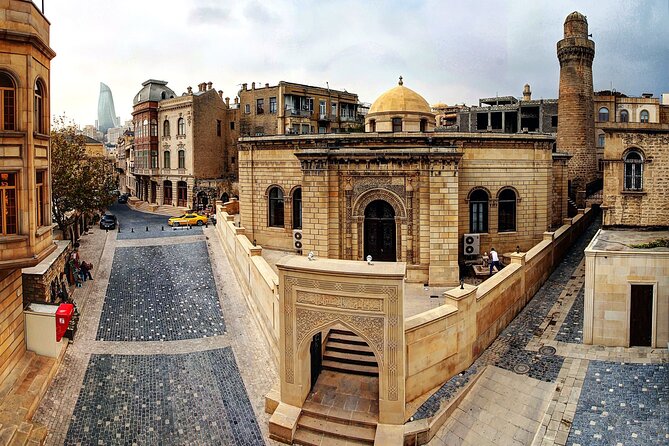
Start at Gosha Gala Square, 47 Kichik Qala. That location matters, because it puts you right where the Old City’s street layout makes sense. You’re not just “arriving at a sight,” you’re stepping into the maze-like logic of Icherisheher, with gates, caravanserais, churches, mosques, baths, and defensive walls all close enough to connect in your head.
The tour is priced at $25 per person, lasts about 2 hours, and uses a mobile ticket. It’s the kind of tour that works well early in your Baku trip, because once you understand how the old town functioned, the rest of the city makes more sense. Even if you only remember a handful of details, those details help you read the architecture as history, not decoration.
The group size cap of 15 people is also a big deal here. In a small group, the guide can adjust pace when people pause for photos, and they can steer you toward the best angles quickly. You’re also less likely to get lost in the flow, which matters in Icherisheher’s tight streets.
How the 2-hour pacing really works, stop by stop
This walk is built like a “greatest hits” route, but with a twist: it favors quick, high-impact visits over long, slow sessions. That’s smart for two reasons. First, you get orientation fast. Second, you can decide later which places you want to revisit for a deeper look.
Here’s how the main stops shape the tour experience.
Gosha Gala Double Gates: the fortification mindset
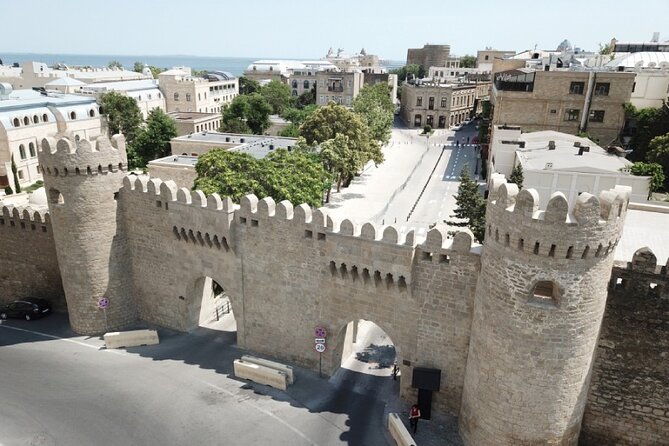
The tour kicks off at the Double Gates, also known as the Baku Old City Gate. Dating back to the 12th century, it’s a UNESCO-linked anchor point that sets the tone: this wasn’t a city that simply grew, it was a city that defended itself and controlled movement. In practical terms, you’ll see a gate that makes sense of the Old City’s walls and towers later on in the route.
If you like architecture that has a job, gates like this are satisfying. They tell you where travelers entered, how the city managed visitors, and why “location” mattered long before GPS.
Caravanserais close the gap between trade and daily life
Next you hit the caravanserais, which are basically the old-town answer to travel infrastructure. The Bukhara Caravanserai (end of the 15th century) has that characteristic courtyard planning where merchants and travelers regrouped after a day on the road. The Multani Caravanserai, from the 14th century, adds a different trade story, including merchants from Multan who frequented the region for business.
What I like here is that the guide’s explanations connect the buildings to routes. You start to picture caravans moving through an interconnected world, not isolated towns. It also makes the Old City feel less like a museum and more like a working place that handled commerce, rest, and security.
Other people showing you the same city
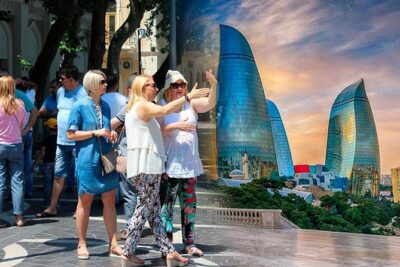
Maiden Tower: iconic exterior, paid interior if you choose
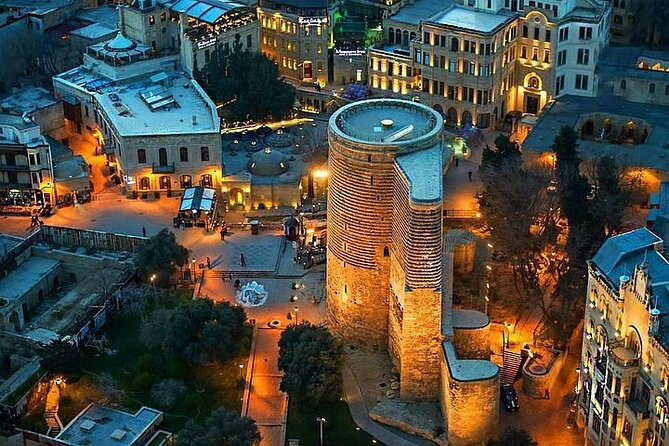
The Maiden Tower is a 12th-century monument and one of the big visual stars of Baku. It sits in the UNESCO-linked historic group with the Palace of the Shirvanshahs. The important practical point is that the tour does not include admission for the Maiden Tower.
So, here’s your decision point. If you only want the best exterior views and the story behind the structure, you’re fine. If you want to go inside, budget extra time and money, since the ticket is not included.
Either way, the guide’s context helps. The tower is not just pretty, it’s a symbol Baku has carried forward for centuries.
Bazar square and the old religious-architectural core
You’ll then pass the area around the old bazar square (also linked with the Khanqah complex). Think of it as the “public life” pocket of Icherisheher, where commerce and religious architecture sit near each other. The route here is useful because it shows you how people built their daily routines around shared spaces, not only around monuments.
St. Bartholomew Church: a different kind of history layer
St. Bartholomew Church was built in 1892, funded by local Christians, on a site believed to be where the apostle Bartholomew was killed in 71 AD. The interior is a small chapel-like Orthodox space, decorated with icons, and the church operated until 1936 before being demolished during a campaign against religion.
This stop works best if you enjoy places where faith history is visible in layers. You get a reminder that Baku’s story is not single-threaded. Different communities lived, built, changed, and left marks.
Baths and caravanserais: where Baku got practical
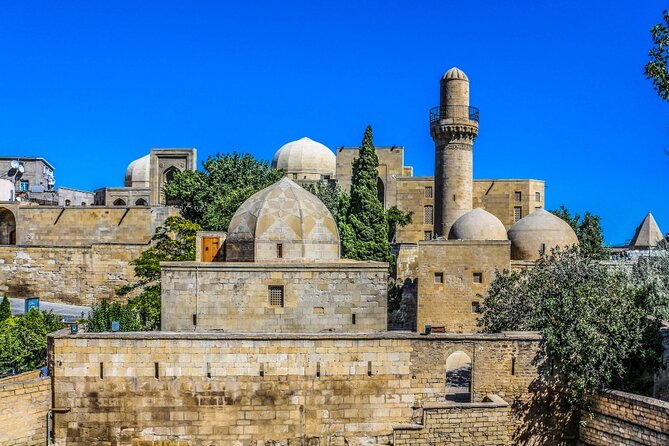
If you want one reason this tour feels different from a basic “stand and pose” walk, it’s the bath stops. You learn how people handled comfort and water use long before modern plumbing habits.
Haji Ghayib or Haji Bani underground bath: the surprise find
You’ll visit the underground medieval bath discovered during archaeological research in 1964. Built at the end of the 15th century, it’s associated with Haji Ghayib (also linked as Haji Bani) and includes architectural features meant to create expressiveness even inside small cells.
The quick guide context matters. You start noticing how design shapes movement and heat. Even in a short visit, the building feels like a system, not a curiosity.
Gasim bey Caravanserai: trade storage with later ownership
The Gasim bey Caravanserai is another 15th-century monument in Icherisheher. After the Baku Khanate joined the Russian Empire, it was used by Gasim Bey and his heirs. That little historical handoff helps you see these buildings as adaptable infrastructure, not frozen relics.
Juma Mosque: restoration dates that anchor the story
The Juma Mosque is tied to inscriptions about restoration ordered in Rajab 709 A.H. (1309), plus a minaret detail completed in 1437. The current Friday Mosque was built in 1899 with financing from a Baku philanthropist merchant, and the site shows traces connected to earlier Zoroastrian temple history.
Even if you’re not chasing religious architecture specifically, the guide uses dates and rebuilding cycles to show how sites persist even when eras change. You come away with a sense of continuity.
The Small Caravanserai and the defensive city logic
The Small Caravanserai dates back to the 12th century and has a square plan with a quadrangular courtyard with cut corners. You also get defensive construction details and entrances that reflect the city’s Middle Age needs.
A good guide will point out how the architecture answers practical questions: where people entered, how they moved, and how the building responded to threat.
Gasim bey Bath, later Green Pharmacy: reuse that keeps history alive
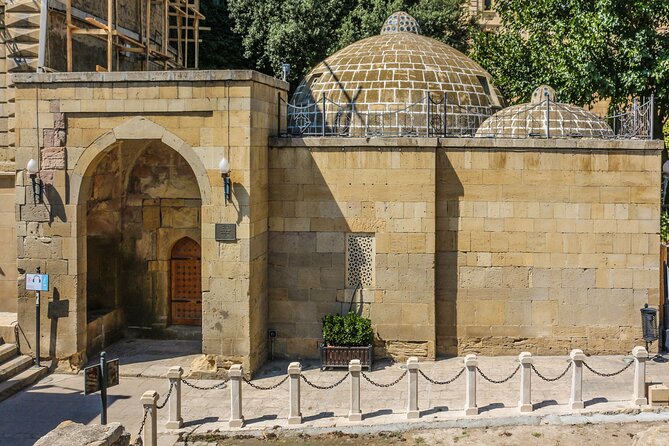
One of the most interesting “wait, what?” moments is the Gasim bey Bath. Built in the 17th century, it’s also known as the Sweet Bath, tied to the idea that bathers received sweets and tea. The building includes rooms like an entrance hall, cloakroom, baths, swimming pools, and a boiler-house, plus ceramic tubes used for heating and water supply.
Then the later twist comes in: in 1970 it was reconstructed and turned into the Green Pharmacy. You’re looking at a historic bath plan that still has a public role today.
Agha Mikayil Bath House: still functioning and architecturally distinct
The Agha Mikayil Bath House is an 18th-century bath on Kichik Gala. Locals refer to the area as the neighborhood of bath amateurs. Unlike some others, it has a large interior, square dressing and bath rooms, pointed arches and domes, plus a chimney above. Restoration in 2010 keeps it operating as a functioning bath.
This stop gives you a strong “then and now” contrast. You see a building type that continued serving real needs, not only posing for tourists.
From Vahid to miniature books and Ali Shamsi
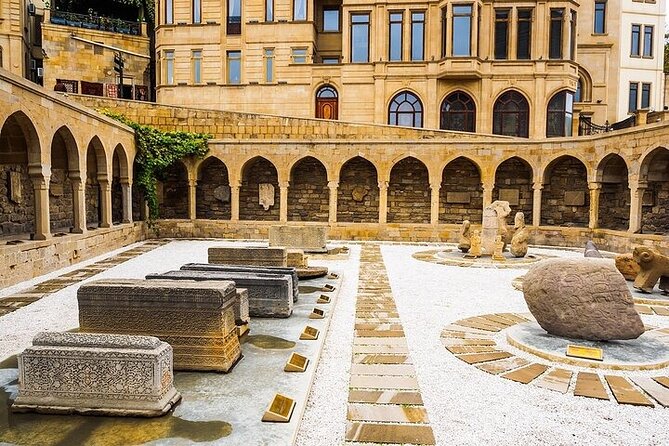
Not all Old City tours feel the same. Many focus only on major monuments. This one adds culture stops that help you understand how modern Azerbaijan layers creativity onto older space.
Vahid Monument: a poet in stone
The Aliagha Vahid Monument honors the poet and ghazal singer Aliagha Vahid (1895 to 1965). It was built in 1990 and designed and sculpted by Rahib Hasanov, with Sanan Salamzade listed as the architect. The project took months and was completed in March 1990.
It’s a quick stop, but it grounds the walk in a modern cultural figure. It also reminds you that Old City identity isn’t only ancient.
Baku Museum of Miniature Books: small books, big record
The Baku Museum of Miniature Books is the only museum of miniature books in the world, located in the Inner City. It began operating on April 2, 2002. In 2015, it received a Guinness Book record for the largest private museum of miniature books.
The collection story is what makes the stop worthwhile: Zarifa Salahova collected more than 6,500 books from 64 countries over about 30 years. The museum opens to promote childhood literacy.
Admission here is listed as free on the tour route, and you get around 10 minutes. That’s not long, but it’s enough time to appreciate what you’re looking at and why the museum exists.
Workshop Ali Shamsi: an artist’s studio visit
Workshop Ali Shamsi functions as an art studio and an attraction connected to the works of Ali Shamsi, an Azerbaijani artist. You’ll hear a background that includes training at an arts boarding school, graduation in 1985, and time working on icon painting. He has been a member of the Union of Artists of Azerbaijan since 1985.
This stop is useful if you like art that feels close to the maker. Instead of a distant display, you get a studio setting tied to local practice.
Shirvanshahs Palace, Beyler Mosque, and finishing at the fortress walls
The Palace of the Shirvanshahs is a 15th-century complex and described as one of Azerbaijan’s architectural pearls. It’s linked with the Maiden Tower as part of a UNESCO-listed historic monument ensemble. Admission is not included for this stop, so you’ll need to decide if you want to pay separately to go in.
If you do choose entry, it’s likely worth it because palace layouts and courtyards help you understand why the Shirvanshahs moved their capital to Baku after a devastating earthquake. If you don’t go inside, you can still follow the guide’s explanation to make the exterior features meaningful.
Near that area you’ll also encounter the Beyler Mosque, located opposite the Murad Gate of the Shirvanshahs Palace complex. It’s listed as a national importance historical and architectural monument.
Finally, the walk ends with the quadrangular tower connected to the Middle Age fortress walls. After restorations in the 1950s, 25 semi-circular towers and one quadrangular tower remained in the wall system. It’s a clean finishing note: the city’s protective shell is still visible if you know where to look.
Value, timing, and who should book
At $25 for about two hours, the value comes from three practical things. You get a guided route, you cover many free-entry stops, and you hit the key Icherisheher themes quickly: gates, trade buildings, religious architecture, baths, and cultural extras.
Here’s where the value gets even better. Because only select major attractions require separate admission, you can keep costs predictable if you focus on the free sights. If you want the full ticket experience for the Maiden Tower and Palace of the Shirvanshahs, you can add that as a flexible choice.
Timing matters in Icherisheher. The streets are tight, and the attention span of a walking tour is real. This route uses short visits to keep momentum. It’s a good fit if you want to orient yourself and pick favorites for later.
This tour also suits you if you:
- Prefer a small group over a large crowd
- Like architecture stories tied to everyday life, especially baths and trade
- Want quick culture stops like the miniature book museum and an artist’s studio
It might not be your best match if you want long museum-style stays at only one or two places. The pacing is designed for movement and context, not extended time inside ticketed attractions.
Should you book this Baku Old City Tour with Alov Travel?
I’d book it if you want a guided way to understand Icherisheher in two hours, especially if you like learning how a city worked, not only what it looked like. The mix of free highlights plus optional ticketed moments makes it feel flexible, and the small group cap helps keep it personal.
If you are the type who wants to linger, plan to revisit your top pick later. Also, check your comfort with paying separately for the Maiden Tower and the Palace of the Shirvanshahs if those are must-dos for you. Do that math in your head before you go, and you’ll have a smooth, satisfying Old City loop.
FAQ
How long is the Baku Old City guided tour?
The tour lasts about 2 hours.
How much does the tour cost?
It costs $25.00 per person.
Where is the meeting point?
You meet at Gosha Gala Square, 47 Kichik Qala, Bakı, Azerbaijan. The tour ends back at the meeting point.
Is admission included for the Maiden Tower and the Palace of the Shirvanshahs?
No. Admission is not included for those two stops.
What is the maximum group size?
The tour has a maximum of 15 people.
Can I cancel for a full refund?
Yes. You can cancel up to 24 hours in advance for a full refund.
The Rest of Our Azerbaijan Reviews

Baku, Start to Finish

Deeper Into the Old City
More of Azerbaijan we have been out and written up
- The Magnificent Baku Night Tour★ 5.0 · 3 reviews
- Small-Group Day Trip to Gobustan, Mud Volcanoes, Ateshgah & Yanar Dagh★ 4.5 · 3 reviews
- Private Sheki Tour – Four Regions of Azerbaijan in one day★ 5.0 · 3 reviews
- Full Day Guided Tour of Shamakhi and Gabala★ 5.0 · 3 reviews
- Qobustan Absheron Full Day Tour★ 5.0 · 3 reviews
Baku Old City Walks, compared.
 ★ 5.0Baku Oil Heritage & Old Town Walking TourFrom $70232 reviews
 ★ 4.5Guba Khinalug & Candy Cane Mountains tour (by Old City Tours)From $79208 reviews
 ★ 4.5Gabala + Shamakhi tour (by Old City Tours)From $59198 reviews
 ★ 5.0Baku Walking Tour (Old City)From $18127 reviews
 ★ 5.0Baku Old Town Walking Tour with a LocalFrom $7864 reviews
 ★ 4.5Baku Old City Tour (officially by Old City Tours)From $2546 reviews
 ★ 5.0Baku Downtown Original Walking TourFrom $1636 reviews
 ★ 5.0Baku Old City Wonders: A Walking Tour Through TimeFrom $3036 reviews
Browse the lists this tour appears in